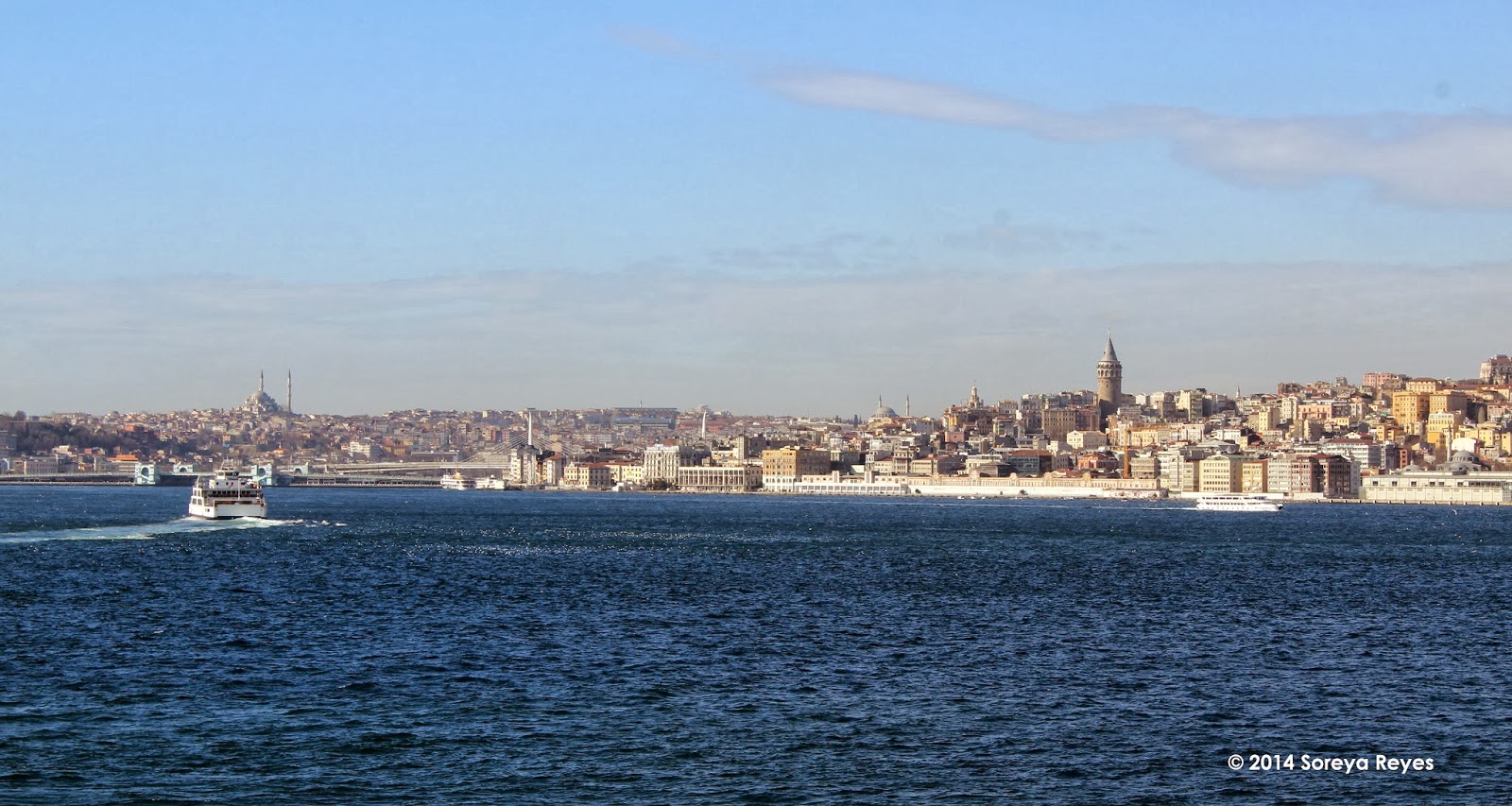
Friday, February 7, 2014

Fortress of Rumeli - Rumeli Hisari

Today's photo trek will take us to the narrowest point of Bosphorus were the Fortress of Rumeli was constructed to control the transit thru the Bosphorus and conquest İstanbul. This magnificent fotress was completed in only 4 months between Abril and August  in 1452 and it played an strategic position on the conquer of Constantinopla by Sultan Mehmed II.

View of the Bosphorus from Rumeli Hisari Northwest tower.
This trek will take two hours if you want to go thru all the towers of the fortress and get really nice pictures of the Bosphorus, the Bridge Sultan Mehmed and the fortress itself. To get to Rumeli Hisari by public transportation you can take 25E or 22 bus from Kabataş İskelesi. The entrance fee is 5 TL and is close on Wednesday.

Rumeli Hisari view from the suth tower.

Fortress of Rumeli is located in Sarıyer district and gives the name of the quarter around it. It was built by Sultan Mehmed II (Fatih) in 1452 overlooking the narrowest point in Bosphorus, opposite of Fortress Anatolia in order to control the transitions through Bosphorus and conquer Istanbul.

Wall window of Fortress Rumeli facing south.

As you sail along the Bosphorus you can hardly miss the enormus fortifications that make up Rumeli Hisari lurkıng just beside the Fatih Sultan Mehmet Bridge. The suburb that greu up around it is well known for its many pleasant water side cafes and restaurants.

View or Rumeli Hisari from the Bosphorus crouise.

The plan of fortress belongs to the Architect Muslihuddin Aga.  The great tower at the seaside was constructed by Grand Vizir Candarlı Halil Pasha, the southwest tower and north tower were constructed under the supervision of Zağanos Pasha and Saruca Pasha respectively. Those towers now bear their names. 

 View of Rumeli Hisari from the Bosphorus crouise.


In a stupendous feat of speed-building, Sultan Mehmed employed 1,000 craftsmen and 2,000 laborers to complete work on the fortress in four months.  Once the fortress was build, Mehmed was able to prevent supplies of grain being shipped from the Back Sea to Constantinople, weakening the city and making its defeat more likely.

Entrance map and history of Rumeli Fortress.


Once Constantinople had fallen, Rumeli Hisari had served its purposes and became a custom collection point. İn time even this fucntion was lost to Rumeli Kavaği (fortress further north to the Bosphorus where the entrance from the black sea)  amd parts of the fortress were used as goal for foreign prisioners of war.

Cannons display at the entrance to the Fortress.

The fortress was badly damaged by an earthquake in 1509, and the floors of two of the towers were lost to fire in 1746. Sultan Selim III had the castle restored but by the 19th century it had been completely abandonded and some locals even set up home insşde the grounds.

View of the northwest tower and wall.

 İn 1953 to celebrate the 500th aniversary of the conquest of İstanbul the fortress was completely restored but with flat roofs to replace the pitched ones.   During this period , the fortress that underwent a great restoration, reached its today's view.   The Fortress of Rumeli open as museum since 1961.

View of the Northwest Tower and Bridge.

Rumeli Hisari has gone under many guises over the years, including  "Kulle i Cedide" (New Castle), Yenice Hisarı (Quite New Castle) and Boğazkesen Kalesş (Bosphorus-dividing castle).

A view of Fatih Sultan Mehmet Bridge from the Southwest tower.

Stairs to the Southwest tower of the Fortress.


View of the Fatih Sultan Mehmed Bridge from the Southwest tower.

View of a door at the South Wall of the Fortress.


View of the Northwest tower from the southwest tower.

Inside the Southwest tower a view of the frame door.

Inside the Southwest tower a view of the frame door.

Inside the fortress a fountain patio looking to the Bosphorus.

Water fountain inside the Fortress.

Magnificent view of Bosphorus from the Northwest tower.


View of the Southwest tower from the north tower.


The wall facing the Bosphorus.

 View of the northwest tower.


Stairs to the North Tower.

Wall of the fortress facing south.


A complete view of Rumeli Hisari from a Bosphorus Cruise.


This Fortress is worth visitng and it is absolute a must photo trek. While you visit İstanbul take your time to visit Rumeli Hisari and enyoy the views!.


Soreya Reyes
www.searchingforemotion.com

STREET LIFE AND DOCUMENTARY PHOTOGRAPHY
Twitter:  @street_photos_
Instagram:  street.photos.soreyar


Wednesday, January 22, 2014

Maiden's Tower - Kız Kulesi

Today's photo trek will take us to the Asian side of Istambul to one of the must picturesque towers of the city:  The Maiden's Tower ( Kıs Kulesi in Turkish).
 
Boat's view of Maiden's Tower.
 
To get to Maiden's Tower from the European side you can take a ferry to Usküdar Iskelesi.  From there you have to walk 15 min.-20 min. to the south sea shore of Usküdar.   The walk is really nice and you can get really nice shots of the European side with a telephoto lens  as well as you can have a short visit to the little mosque of Şemsi Pasha.    

Maiden's Tower view of the sea shore of Üsküdar.

The trek will take from two to three hours and you will have to take a little boat to the Maiden's Tower.  The entrance is 20 TL that includes the boat to the islet.

Şemsi Pasha Mosque's View from Üsküdar İskelesi.
 

15 min walk from Üsküdar İskelesi to Maiden's Tower.
 
 Flower's vendor on the way to Maiden's Tower. 
 
 Just strait 200 m (220 yd)  off from the coast of Üsküdar in İstanbul, the cute little Maiden's Tower crops up in many old pictures of Istanbul and has attracted many romantic stories over the years. After the most recent restorarion, it houses a restaurant and small cafe, and offees 360°  city view from its balcony. 
 
Sea shore of Üsküdar.
Although the Tower currently standing on the rock off Üsküdar dates back only to the 19th century the earliest building there seems to have been a small fort built by the Athenian general Alcibades in 408 BC to keep the Persians at bay.  Later the Byzantine Emperor Manuel I Comnenos (1143-80) had a miniature castle created to discourage invaders.   Sultan Mehmed the Conqueror replaced this mini castle with one of his one which was restored by Sultan Selim I. 

 
Private boats make trips to the tower. 
 
 A view of Maiden's Tower and Sultanahmet from Usküdar sea shore.


Like so many buildings in İstanbul, the Maiden's Tower has also fallen foul of a fire, this time on started by torches at a party that got out of control ın 1719.  It was replace almost immediately by Sultan Ahmed III's Grand Vizir Damat İbrahim Paşa at wich point it appears to have been turned into a lighthouse.  The final version was created by Sultan Mahmud II in the early 19th century. 
 
.
Candelabre at Maiden's Tower entrance.
 
The interior of the tower has been transformed into a popular café and restaurant, with an excellent view of the former Roman, Byzantine and Ottoman capital.  


Entrance to Maiden's Tower Restaurant.
 
Restaurant at Meiden's Tower.
 
A la carte dinners are served on the ground floor of the tower where the only vies are though small side windows.  Alternatively, you can down a tea or coffee at the top floor cafe which some might argue is the nicer venue anyways.
 .
 
The Legends
 
There are many legends about the construction of the tower and its location.  On the way to the top of the tower you can see each level has a wall paints with the fabulous stories tight to this building.  
 
 
Legend of Leandro's Tower.
  
The older name Leander's Tower comes from a story about a maiden: the ancient Greek myth of Hero and Leander. Hero was a priestess of Aphrodite who lived in a tower at Sestos, at the edge of the Hellespont (Dardanelles). Leander (Leandros), a young man from Abydos on the other side of the strait, fell in love with her and would swim every night across the Hellespont to be with her. Hero would light a lamp every night at the top of her tower to guide his way.

Succumbing to Leander's soft words, and to his argument that Aphrodite, as goddess of love, would scorn the worship of a virgin, Hero allowed him to make love to her. This routine lasted through the warm summer. But one stormy winter night, the waves tossed Leander in the sea and the breezes blew out Hero's light, and Leander lost his way, and was drowned. Hero threw herself from the tower in grief and died as well. The name Maiden's Tower might also have its origins in this ancient story.

Legend of the Snake in the Basket.

According to the most popular Turkish legend, an emperor had a much beloved daughter and one day, an oracle prophesied that she would be killed by a venomous snake on her 18th birthday. The emperor, in an effort to thwart his daughter's early demise by placing her away from land so as to keep her away from any snakes, had the tower built in the middle of the Bosphorus to protect his daughter until her 18th birthday. The princess was placed in the tower, where she was frequently visited only by her father.

On the 18th birthday of the princess, the emperor brought her a basket of exotic sumptuous fruits as a birthday gift, delighted that he was able to prevent the prophecy. Upon reaching into the basket, however, an asp that had been hiding among the fruit bit the young princess and she died in her father's arms, just as the oracle had predicted. Hence the name Maiden's Tower.

Legend of Battal Gazi.
 
The Turkish hero Battal Gazi was an eight century Umayyad soldier who used to farm land inmediately across from the tower and fell in love with the Byzantine emperor's daugher.  While he was away fighting in Damascus, the emperor imprisoned his daughter on the rock.  On his return Battal Gazi was able to free her, but only with the help of a highly unlikely sounding 700 soldiers. 

. 
 
360 Degree View of Istanbul
 
 
Once you are a the top of the tower you can enjoy the 360 degree view of İstanbul.
 
View of Galata Tower from the top Café of Maiden's Tower.
 
 
Maiden's Tower Café.


View of Bosphorus and Torre Galata from Maiden's Tower.


View of Üsküdar Beledeyesi from Maiden's Tower.


View of Üuskudar from Maiden's Tower.
 
 
View of İstanbul's Port from Maiden's Tower.


Suleymaniye's view from a Maiden's Tower window.


 View from the Top of the tower to the islet.
 
 
View of Topkapı Palace, Hagia Sophia and Blue Mosque from Maiden's Tower.
 

Lighthouse at Maiden's Tower islet.

  
A view of Maiden's Tower from Ferry to Kadiköy.
 
I hope you enjoyed the views!. 
 
Soreya Reyes.
 
 If you are interested in a photo guide trek in Istanbul inbox for more info: istanbulphototrek@hotmail.com
 

Thursday, January 9, 2014

Galata Bridge Photo Trek

I've been thru Galata Bridge many times but never did a photo trek on it.  This is the first trek of the year for me and I was lucky the light was beautiful today.   I've got to explore the great Galata Bridge, it's angles, limits, frames and finally  it's people. 

This photo trek takes two hours.  İt is only one bridge but you need time to go upside down, back and forth and explore the great views of the city and the bridge by itself. 

You can start from Karaköy at Beyoğlu District and go all the way down to Eminönu and change perspectives from one side to the other.  There are stairs that will take you to the Restaurant floor and also there are tunels between restaurants that will take you from one side to the other without having to go upstairs again.
 
 
The Galata Bridge (in Turkish Galata Köprüsü) is a bridge that spans the Golden Horn in Istanbul, Turkey. From the end of the 19th century in particular, the bridge has featured in Turkish literature, theater, poetry and novels.
 
 
  View of Galata Bridge from Karaköy to Emınönu
 
It is said that Sultan Beyazid II commissioned Leonardo da Vinci to design a bridge to span the Golden Horn in 1503, only 50 years after the city was captured from the Byzantines. The great artist and engineer did the design, showing a single span bridge with double pillars at either end, 350 m long and 24 m wide but alas the bridge was never built.
 
 
View of Karaköy from the restaurant level.

Another Italian artist, Michelangelo was invited to design a bridge for Istanbul. Michelangelo rejected the proposal, and the idea of building a bridge here was shelved until the 19th century. In the early 19th century Mahmut II (1808-1839) had a bridge built at some distance up the waterway between Azapkapi and Unkapani. This bridge, known as the Hayratiye, was opened on 3 September 1836. The project was carried out by Deputy Lord High Admiral Fevzi Ahmet Pasa using the workers and facilities of the naval arsenal. According to the History of Lutfi this bridge was built on linked pontoons and was around 500 to 540 m long.


Karaköy's hotels and restaurants.
 

The first Galata Bridge at the mouth of the waterway was constructed in 1845 by the mother of Sultan Abdulmecid and used for 18 years. It was known as the Cisr-i Cedid or New Bridge to distinguish it from the earlier bridge further up the Golden Horn, which became known as the Cisr-i Atik or Old Bridge.

 
  View of Haya Sophia from Galata's bridge cafe.
 
The New Bridge was built by Abdulmecid Han. First to pass over the bridge was Sultan Abdulmecid, and the first to pass below it was the French captain Magnan in his ship the Cygne. For the first three days crossing the bridge was free, after which a toll known as mürüriye was paid to the Naval Ministry. 
This was replaced by a second wooden bridge in 1863, built by Ethem Pertev Pasa on the orders of Sultan Abdulaziz in readiness for the visit to Istanbul of Napoleon III.


Turkish woman walking from Eminönu to Karaköy with the New Mosque as background.

In 1870 a contract was signed with a French company, Forges et Chantiers de la Mediteranée for construction of a third bridge, but the outbreak of war between France and Germany delayed the project, which was given instead to a British firm G. Wells in 1872. This bridge completed in 1875 was 480 m long and 14 m wide and rested on 24 pontoons. It was built at a cost of 105,000 gold liras. This was used until 1912, when it was pulled upstream to replace the now genuinely old Cisr-i Atik Bridge.
 

  Fishermen. View from Karaköy.
 
The fourth Galata Bridge was built in 1912 by the German Man firm for 350,000 gold lira. This bridge was 466 m long and 25 m wide. It is the bridge still familiar to many people today that was badly damaged in a fire in 1992 and towed up the Golden Horn to make way for the modern bridge now in use.


View of the New Mosque view from Galata bridge.

The present Galata Bridge, built in 1992, replaced a much-loved pontoon bridge dating from 1912 that gently swayed and rolled as the seas moved beneath it.

View of Karaköy Iskelesi from Galata's bridge cafe.


Pipes from Dersaadet Cafe at Galata Tower. 
 
Fisherman with Galata Tower background.
 
 
Fisherman at Galata bridge with Galata tower as background.


Karaköy Iskelesi view of Haya Sophia.

Fisherman unhanging fish : )

View of Karaköy from restaurant level at Galata bridge.

View of Eminönu (Süleymaniye mosque) from Galata bridge.

View of the new metro bridge from Galata bridge.

 Fisherman with Süleymaniye mosque background.

 
Fisherman at Galata Bridge.

Fisherman with Galata tower as background.

Eminonu's view from Galata's bridge.

Eminönu's view from Galata bridge. (Süleymaniye mosque and Rüstem Paşa Camii)
 

  Galata tower from Eminönu.


I wish you all a year full of light and great moments. I hope this year I can share many more great phototreks with you and grow as a photographer, learn new techniques, change perspectives and be amazed by the beauty around us.
 
Soreya Reyes

Ps. If you are interested in a photo guide trek in Istanbul inbox for more info:
soreya_reyes@hotmail.com